Monday, 3 May 2021

Nomadland - simply a masterpiece


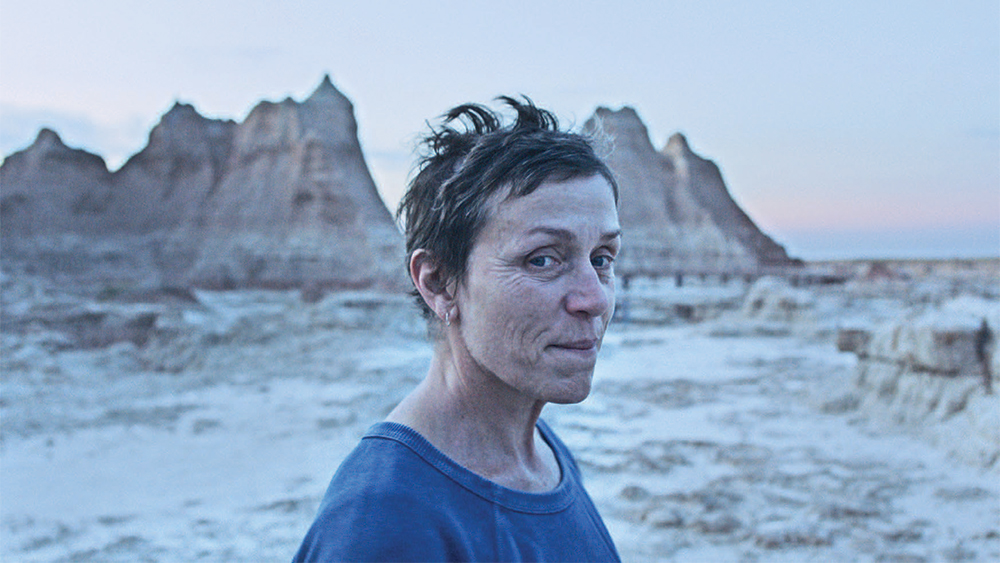
Nomadland is an American classic, a masterpiece. Not just as a film but as a piece of art. Choe Zhao’s achingly tender story of modern nomads is as quintessentially American as a John Stenbeck story, or an Ansel Adams photograph, or a Georgia O’Keefe painting. There is something in this film that touches our core and speaks to us about who we are. Anyone watching Nomadland unmoved is genuinely more to be pitied than scorned.

On one level the film is a 21st century tragedy, on another it is an inspiration. Fern (Frances McDormand) has been recently widowed. Along with the loss of her soulmate comes the loss of her home when the company town she lived in effectively disappears; part of the inspiration for the film is the town of Empire, Nevada, whose postal code was discontinued as a result of globalisation.

Fern remains quietly undaunted. She makes the best of her situation, for example, pointing out to one former neighbour that she is not ‘homeless’ but ‘houseless’. The distinction speaks volumes for Fern’s character and the delivery of the line is a testament to McDormand’s peerless performance.

Fern takes to the road in search of seasonal work at an Amazon depot and begins to live in her van. Incidentally for those who claim that the picture portrayed of Amazon is too benevolent, see my comment earlier about more pitied than scorned. This is not a Michael Moore documentary, thank God, it is a film about dignity, humanity, and fellowship.

Finding friends everywhere she goes Fern discovers a sub-culture of modern American nomad who live on the road. These are not Kerouac style beatniks, they are simply people who, for one reason or another, have disconnected from the 21st century and found a life on their own terms. Most of the cast are drawn from these nomads which gives the film an air of authenticity.

Fern with her haunting melancholy undiminished is something of a participant observer in this community but she finds something in them to salve her soul and takes to the life of a nomad. Along the way she meets Dave (David Strathairn) potentially a kindred spirit, but not so much of a kindred spirit that would lead writer-director Zhao into the realms of cliche and convention.

Dave is the catalyst for a final act which reveals a little more about Fern and her relationship with friends and family. This could so easily have been a faux transcendent ending, instead – as she did in Three Billboards – McDormand offers us resolution rather than redemption.

Nomadland is a film about grief, and loss, and the consolation of humanity. It also speaks eloquently of the healing power of nature and the importance of recognising that our corporate culture is not the only way.  It calls to mind Steinbeck – not so much The Grapes of Wrath for me as Travels with Charley – and reminds us that there may still be some decency left in the world.

The film looks magnificent, shot by Zhao’s usual cinematographer Joshua James Richards. His use of natural light – especially in the golden hour – and a gently roaming handheld camera produces glorious images which are perfectly complemented by Ludovico Einaudi’s score.

At the heart of this film is McDormand. As Fern she contributes one of the great performances in the history of American cinema. So much is non-verbal. One of her very first scenes, in which she briefly embraces her dead husband’s work jacket, sets down a marker for what is effectively a master class in screen acting to follow.

That scene with the jacket recalled for me the moment in The Searchers (1956) in which Martha briefly embraces Ethan Edward’s coat in a scene that mutely but eloquently charts their unspoken love. The Searchers in particular and John Ford’s work in general came back to me several times in Nomadland.

The obvious visual comparison is with the films of Terrence Malick, and I get that, but for me Ford – who directed Grapes of Wrath – is a better tonal comparison. Like Ford at his best Nomadland is peopled with characters so believably organic that they seem to have sprung from the very land they inhabit. It is a work of genius that should on no account be missed.


Tuesday, 20 April 2021

Promising Young Woman is one of the films of the year


Comedy is like chocolate. If it’s soft and sweet it’s no use, but if it’s dark and bitter and brittle it can be a thing of beauty. Promising Young Woman is a film so dark it won’t allow light to escape and as a consequence is immensely satisfying. The best thing is that it achievs its considerable triumph by stealth.

This is a grand bait and switch manoeuvre perpetrated by writer-director Emerald Fennell and producer-star Carey Mulligan. It looks like a romcom. There are so many pinks and blues and pastel hues it feels like you have accidentally tuned in to Legally Blonde. But although it may have the look of a romcom it has the soul of a Saw movie.

Cassie (Mulligan) looks like a rootless Gen Z slacker living working a McJob in a coffee shop and living with her folks (Clancy Brown and Jennifer Coolidge). They’re a lovely couple, and supportive too but when they give her a suitcase – shocking pink naturally – for her 30th birthday the message is clear.

The audience however knows that Cassie is a woman on a mission. We have already seen her, blind drunk, in a nightclub being picked up by a predatory man. They go back to his place; he discovers that Cassie is faking – a bait and switch of her own – and another name is added to her list.

Cassie’s plan is to confront men with their poor moral choices and scare them straight. Her friend Nina was a victim of these men and now Cassie wants revenge.

It looks as if things might change with the arrival on the scene of a former classmate, Ryan (Bo Burnham). Her parents are thrilled to meet this nice young man, Perhaps Cassie can be saved by the love of a good man? What do you think?

Cassie is not so easily swayed. As she becomes more wrapped up in her quest it is obvious that she is prepared to sacrifice literally anything and anyone to achieve her ends. It is this determination that takes us to an ending that appears to divide audiences but which, for me, is perfect in its audacity and execution.

Promising Young Woman is a provocative piece. It is a film given pointed significance by the likes of Harvey Weinstein, Woody Allen, and the MeToo and TimesUp hashtags.

It is also a film that highlights our tendency to protect the guilty and punish the victim. One of Cassie’s darkest and cruellest schemes is reserved for a powerful woman who did nothing to intervene with Nina. It’s a reminder of Madeleine Albright’s quote about a special place in hell for woman who don’t support other women.

 Promising Young Woman is incredibly well-written by Emerald Fennell who also makes anassured directorial debut. The lead performance from Carey Mulligan is remarkably brave and the results are genuinely memorable with a movie that is as much a talking point as a film.


Tuesday, 9 February 2021

Read all about it - News of the World is another Hanks triumph


Tom Hanks is the closest thing we have these days to a Golden Age of Hollywood style movie star. In fact, the actor to whom he is most often compared is James Stewart, the very quintessence of Golden Age stardom. The archetypal everyman, the paragon of decency who could be relied upon to do the right thing. Except in one memorable run of roles where he couldn’t.

Stewart reinvented himself with a series of Westerns with Anthony Mann in the Fifties in which he had a memorable run of dark and troubled characters. From Winchester 73 (1950) to The Man from Laramie (1955), he played a series of roles that were the very antithesis of his ‘good neighbour Sam’ typecasting. They are marvellous films which helped to cement Stewarts reputation as one of the greatest screen actors ever.

The demise of the Western has created a lacuna in Tom Hanks’s career. I know there are few cowboys more famous than Sheriff Woody in the Toy Story franchise, but he has missed out on the chance to make a proper Western until now.

As it happens News of the World shows us a different aspect of Hanks’ stardom just as Anthony Mann did for James Stewart. If his character is not as dark and troubled as Stewart was in his westerns, he is at least haunted by his actions and his past.

Directed memorably by Paul Greengrass, News of the World is the story of Captain Jefferson Kyle Kidd (Hanks) who travels across Texas in 1870 eking out a living by giving public readings of newspapers to remote towns where the locals are eager for news. These are anxious times, the Civil War has just ended, the telegraph has not yet arrived, so in that sense Hanks is a metaphor for progress. In this age of manifest destiny his news, generally about the progress of the railroad, is life or death for these small towns.

 Hanks comes across a young German immigrant Johanna (Helena Zengel) whose parents and family have been killed by a Kiowa raiding party. When no one in town will take her in, Hanks realises he will have to do the decent thing and ferry her cross country to find what remains of her extended family. The journey is frequently hazardous but eventually a bond forms between these two who are each harried by what they have seen or done in their past.

 For long stretches of the film there is not a lot happening but the characters and performances of Hanks and the excellent Zengel create a companionable mood full of nuance and meaning. You begin to suspect that each might be the other’s salvation. It is only in the final act when the story reveals itself that these moments of nuance resolve into genuinely affecting drama.

 This is a very different film from Paul Greengrass’s usual work. The man who gave us the anxious kineticism of the Jason Bourne movies seems perfectly at home with the formalism of the classic Western. He has an eye for a frame and his ciematographer Dariusz Wolski captures it perfectly.

 In the midst of all of this there is Hanks, a man who stopped acting a long time ago in favour of simply being. As he does in most of his recent roles, Hanks inhabits the picture with a grace and subtlety that defies description. Like James Stewart he makes it look effortless and, like Stewart, he doesn’t get anything like the credit he deserves.

 A word too for newcomer Helena Zengel whose adamantine performance gradually reveals a vulnerable interior without a trace of unearned sentiment, and praise too for a wonderful soaring score from James Newton Howard. Someone else who makes it look too easy and probably won’t get the Oscar he deserves.

 In troubled times News of the World is a comfort as well as an inspiration. It reminds us of the blessings and virtues of fresh starts which, hopefully, we will all get to have in a short time.

Last Night in Soho offers vintage chills in fine style

The past, as L.P. Hartley reminds us, is a foreign country where they do things differently. Yet we are often inexorably drawn to it in th...