Sunday, 22 September 2019

In Ad Astra, Brad Pitt reaches for the stars


James Gray, for my money, is a very underrated director. Since his feature debut with Little Odessa (1994) he has quietly put together an impressive body of work with enough of a connecting thesis to merit being treated as a genuine auteur. He doesn’t make many films but they all tend to have something to say and they are worth the wait.

Gray’s films look at masculinity, He is not overly concerned with the toxic sort that Scorsese for example finds so fascinating, he tends to look at masculinity in a family setting. Whether it is in The Yards (2000) or We Own the Night (2007) or The Lost City of Z (2016), Gray’s characters are caught up with a drive to find their own destiny while at the same time conforming to the demands of their familial responsibilities.

Ad Astra is perhaps the most considered example of the Gray canon so far. It is the story of an astronaut (Brad Pitt) who is sent on a mission to find his long-presumed dead father (Tommy Lee Jones). The older man was presumed lost in space but appears to be still alive and in charge of technology which threatens the future of the earth.

Although there are a lot of action scenes in the trailer this story, set in the ‘near future’, is thoughtful and cerebral and has questions to ask about a sense of self and indeed the nature of humanity. There are strong religious undertones in some of the dialogue which suggests the future may be more theocratic than secular, and this adds a particular resonance to a son atoning for the sins of the father by sacrificing himself for the good of mankind.

There are clear influences from the likes of Lem’s Solaris or Conrad’s Heart of Darkness in the way Gray tells his story. There is much inner monologue which can be the kiss of death in some films but here Pitt’s musings are quietly seductive and draw you into the story.

The second half of the film is a little more action-packed than the first and there are one or two sequences – such as the Moon pirates or a mysterious mayday call – that look like they might be going down the route of a larger conspiracy theory.  Is someone trying to thwart the mission? However Gray eschews all of this stuff in favour of Pitt’s personal journey of discovery as he searches for empathy, meaning, and opening up to emotion.

I’ll concede that some might find this a little pretentious but it resonated with me and I had no issues with it. The film is a little slow in places but Hoyte van Hoytema’s stunning cinematography creates an immersive experience which is augmented by Max Richter’s ethereal score.

The cast it littered with big name support – Donald Sutherland, Ruth Negga, Liv Tyler, Natasha Lyonne for example – but this is Pitt’s film. I cannot imagine any other actor who can pack so much nuance and meaning into an apparently expressionless face.The camera has always loved Pitt, now in his maturity it adores him. Pitt’s close-ups dominate this film but they are endlessly fascinating, unlike George Clooney’s in the most recent version of Solaris (2002) which are just bland.

This may not be everyone’s cup of tea but I found Ad Astra utterly compelling, even with the space monkeys, and I was absorbed from first to last.

And, who knows, with this and Once Upon a Time…in Hollywood, it could be Brad Pitt’s year after all.

Tuesday, 13 August 2019

Once Upon a Time...sets a high bar for Oscar


Whether or not Once Upon a Time…in Hollywood is Quentin Tarantino’s masterpiece will have to wait until he calls time on his career. However it is, by some considerable distance, the finest film of his career to date. More important than that, even separated from his own body of work, this is a stunning piece of cinema that left me gasping with astonishment by the end.

Once Upon a Time… in Hollywood shows what can be done by a director who has finally hit a career sweet spot. My biggest criticism of Tarantino is that he is a writer of great scenes – even in his worst movies – but is not a teller of great stories. This one is different. This shows what can be done with masterly storytelling combined with superb craft skills – of which more later – and marvellous performances.  

It is, without doubt, the first serious Oscar contender of the year and sets a very high bar in the process. The only thing holding it back for me is his continued sophomoric treatment of women which in the era of #metoo and given his own personal history is hard to fathom.

Tarantino is famous for his movie geekery but this is the first time it has been put to good use; his overwhelming knowledge of the period informs almost every frame of the film. It is steeped in nostalgia for the good old days of the studio system but in a very constructive way.

The story is set across three separate days in 1969 in the last knockings of the studio system. By the start of the film New Hollywood has already announced itself with cutting edge work such as Bonnie and Clyde (1967) and The Graduate (1967) while the studios are still churning out loss-making overstuffed turkeys such as Hello Dolly (1969), one of many films referenced in the production design of this one.

Although set in Hollywood, the focus of this story is on the small screen. Rick Dalton (Leonardo DiCaprio) is a fading television star whose life is on a downward spiral. His declining career path is outlined in a brutal scene with small-time producer Al Pacino. Rick’s only friend is his constant companion Cliff Booth (Brad Pitt), a former stuntman who harbours a dark but open secret. It’s rumoured he murdered his wife and, while not a key plot point, is referenced often enough to make him the most interesting character in the movie.

The other central figure in the story is Sharon Tate (Margot Robbie); 1969 was infamously the year of the Manson Family massacres and those of us old enough to remember it spend much of the picture wondering how this fits into the story. That it does, and seamlessly, is a tribute to Tarantino and his skills. As I said, the writer of great scenes is now the teller of a great story.

In its own way this film is a tribute to Sharon Tate who was a huge star in the making and apparently much-loved. She is presented here as a blithe spirit, a force of nature, and a breath of fresh air amid the stale corruption of Hollywood.

Tarantino has been criticised for her lack of dialogue, and it’s true she doesn’t say much but neither does Pitt. For me, her lack of lines need not include her among Tarantino’s other infamously silent women. I’m not sure what else we needed to know about Tate, in story or historical terms, other than what we see here. She is an idealised character but, for me, that was the point.

Once Upon a Time…in Hollywood is a very mature film. His usual dazzling dialogue and flashy camera work is substituted here by classic Hollywood filmmaking; this is a film that looks like it could have been made when it was set. Robert Richardson’s sublime cinematography allows for one ostentatious camera movement, but even that is revealed to be in service of the story.
The film feels substantial and everything about it seems right; the production posters in the background, the film titles on cinema marquees, the news stories and songs on the radio. The art direction and sound design are magnificent and the film would be much less immersive without their efforts.

DiCaprio gives another faultless performance but he is perhaps just shaded by Pitt who has that rare quality in this picture of making you wonder where he is every time he’s off screen. The supporting cast is excellent too and again Tarantino’s inner geek comes to the fore. The film is set in the world of TV so the cast comes from a motley crew of current and former TV stars. If you’re quick you can spot the likes of Nicholas Hammond, Clu Gulager, Martin Klove, Brenda Vaccaro and the late Luke Perry among the cast.

The look and sound of the film is perfect and Tarantino’s handling of the mood is faultless. The key scene for me is when Brad Pitt accidentally finds himself at the home of the Manson family. It suddenly seems like we might be in Rob Zombie territory and there is genuine, uncomfortable tension throughout. It’s a transgressive moment that shifts the tone of the film.

From here on the mood is darker, but still substantial, until we come to that glorious bait and switch ending. I had a number of minor issues throughout the film – the Bruce Lee sequence for example – but the ending is like a lightbulb moment where you suddenly realise where the film has been leading you. The clue is in the title.

Once Upon a Time…in Hollywood is a stunning piece of work and two weeks later I am still thinking about it and can’t wait to see it again. I have no interest in Tarantino’s indecision about how many more films he makes. If he never makes another it wouldn’t bother me. I’m just glad he made this one.

Thursday, 8 August 2019

Bend it Like Springsteen


In many ways Blinded by the Light is a male version of the same director’s breakthrough hit Bend it Like Beckham (2002). I don’t mean to suggest that Gurinder Chadha is repeating herself, only that she is revisiting a previous topic through a different prism.

Both films deal with transgressive activity. In Bend it Like Beckham, Parminder Nagrah is a young Sikh woman who rebels against a traditional family by playing football. In Blinded by the Light, Viveik Kalra’s rebellion comes in the form of the music of Bruce Springsteen.

Based on the memoir by Sarfraz Mansoor, Javed (Kalra) is a young man in Luton in 1987 who is keen to make his mark on the world. He wants to be a writer but in Thatcher’s Britain there aren’t many opportunities of any sort for young Asian men. In addition there is the need to provide financially for the family and to fulfil the expectations of his traditionalist father Malik (Kulvinder Ghir).

Javed’s salvation comes when he discovers The Boss. Interestingly at this point in his career Springsteen had become unfashionable for a generation of synth fans, which makes Javed’s decision doubly transgressive. But he is moved and inspired by Springsteen's lyrics and despite all opposition, with the support of an enlightened lecturer (Hayley Atwell), he finds a path to a brighter future.

The USP of Blinded by the Light is that it has Springsteen’s benediction which means they can use the music. They do tend to stick to the best known songs – it’s a bit like a short playlist on shuffle – but they are used very effectively.

Chadha’s technique of, in some cases, presenting the lyrics on screen or in the physical confines of the set is very effective and gives the audience the chance to appreciate the undoubted power of the words. In other areas she treads a fine line between a conventional jukebox musical and Bollywood but the overall combination is bright and fun.

The politics of Thatcher’s Britain form a backdrop for much of the story but for me, there wasn’t the threat that there might have been. The National Front is presented almost as an afterthought and scenes of small boys urinating through the letter boxes of Asian families seemed a little distant and formulaic. The economic hardship of Javed’s family and the working classes in general might have been explored a bit more for me.

Fundamentally though this is a Gurinder Chadha movie not a Ken Loach film. It aims to entertain first and foremost and it does that very well. The energy of the film is infectious, Kalra is a likable hero, Kulvinder Ghir gives a terrific performance as his conflicted father, and it would take a heart of stone not to be moved by the ending.

The music of course is great and if Blinded by the Light is the sort of film that we don’t make too often in this country, we should be grateful to have someone who can make them as well as Gurinder Chadha.

Friday, 2 August 2019

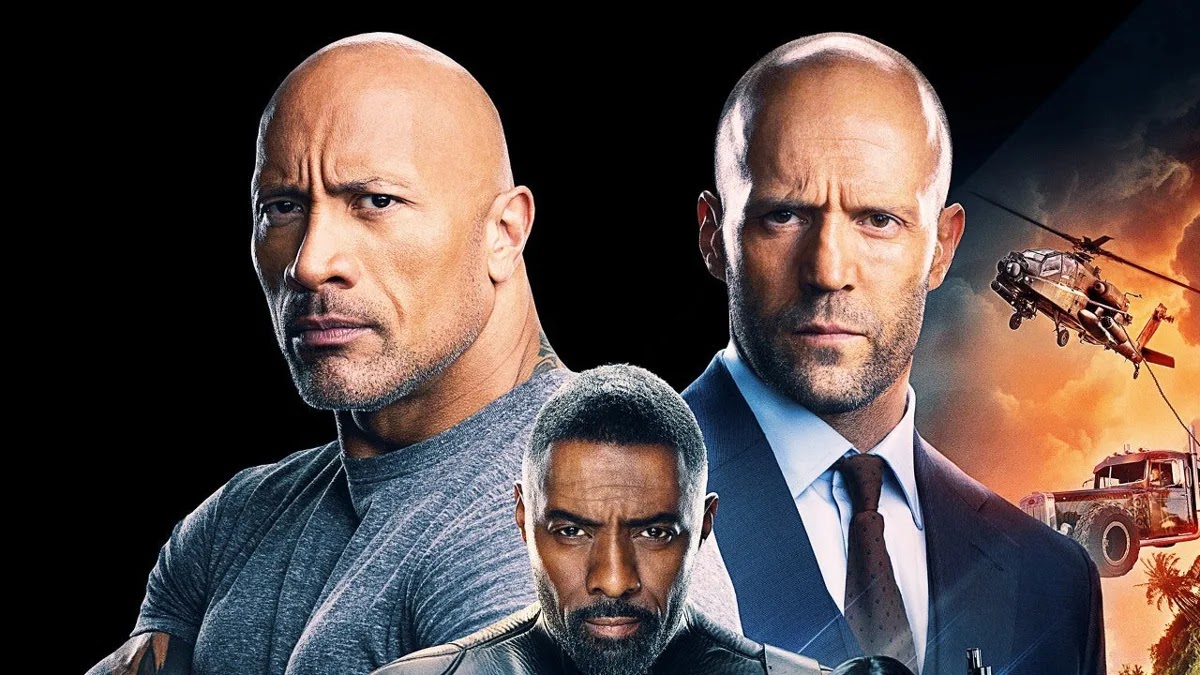
Hobbs and Shaw is fast and furious fun


This film’s Sunday name is Fast & Furious Presents: Hobbs and Shaw which is a cumbersome and slightly obvious way of tying it into a 5 billion dollar franchise. The notion that a film starring two of the biggest action stars in the business needs a bit of superfluous branding to guarantee box office success is just silly.

The reviews will be sniffy but the men and women behind Hobbs and Shaw – because, be honest, that’s what everyone is calling it will be laughing all the way to the bank. This is a film that promises exactly what it delivers and exactly what the audience wants, and that is a sure-fire recipe for success.

Apart from the fact that Luke Hobbs (Dwayne Johnson) and Deckard Shaw (Jason Statham) are key characters in the Fast and Furious franchise – in fact they gave it a much-needed shot in the arm when they turned up- there’s not much to connect this to the source material. This is more along the lines of vintage Eighties buddy action cinema. Tango and Cash (1989) comes to mind and that’s fine by me.

The plot, such as it is, concerns a deadly super-virus which threatens all mankind. Our polar opposite heroes form a mismatched team to prevent the bug from falling into the hands of genetically-enhanced supervillain Brixton (Idris Elba). The bigger issue is that the virus is currently in the blood stream of Vanessa Kirby, playing Shaw’s sister Hattie, and they have only 72 hours to extract it and contain it safely.

It’s all so much nonsense, as most of these plots are. What matters here is the execution and this is a first class example of 21st century action cinema. The heroes are oversized, the script is appropriately bantery, the stunts are spectacular, and the craft skills involved are highly impressive. A shout out too for the Glasgow locations which look impressive and seamlessly integrate with the other footage.

This is a film that does exactly what it says on the tin and that’s exactly what I want to see at this time of year.

Johnson and Statham are very good at doing what they do. They each exude their own particular brand of macho without too much difficulty. The real issue with the film for me is Idris Elba who is something of an empty suit as the bad guy. While Johnson and Statham provide a casual sort of stardust, Elba is just trying too hard.

The bad guy is a plum part in an action movie – think Alan Rickman or Jeremy Irons in the Die Hard franchise for example. Here Elba stands around spouting some heavy handed exposition and the film passes him by; it’s a role anyone could play.

The one standout performance for me – apart from two knock-out surprise cameos – comes from Vanessa Kirby as Shaw’s sister. Just as in last year’s Mission: Impossible – Fallout she is the buffer zone for all this testosterone and again does it very well.  Her character has agency in her own outcome, doesn’t need any rescuing, and contributes on the same level as the others – we could do with more of that.

The one thing that did strike me about Hobbs and Shaw and Mission: Impossible for that matter is how irrelevant they appear to have made the Bond franchise. The current James Bond movie is beset by all sorts of unfortunate problems but to be honest if it was never released, I don’t think I would miss it.

The Bourne series along with Fast and Furious and Mission: Impossible have reinvented themselves for contemporary audiences. Bond still seems mired in the 20th century so perhaps it’s time to hang up his shoulder holster and make way for the inevitable Hobbs and Shaw franchise.

Tuesday, 23 July 2019

The Current War is a fairly low wattage affair


The Current War has spent so much time wandering in the cinematic wilderness that I really wanted to like it more than I did. Unfortunately the story of the film’s time in movie purdah may be the most interesting thing about it.

The film was screened at the Toronto Film Festival two years ago and was all set for release in October 2017. However as a Harvey Weinstein production it got caught up in his legal troubles and the demise of his company. In the end all trace of Weinstein has been removed from the credits, the film has been sold to new distributors and goes on release in the UK this month and the United States in October – just two years late.

In a perfect world The Current War would be the little movie that could; triumphing over adversity and sweeping all before it at the Oscars. Sadly this is an imperfect world and its chances are slim.

Like most films showcased at Toronto this was originally seen as an Academy Awards contender. It ticks a lot of Oscar bait boxes; serious subject, period drama, big cast in mutton chop whiskers, lavish production values, and educational too. In the end though this is a pretty workmanlike affair which fundamentally lacks drama and tries to cover too much ground.

Set in the latter part of the 19th century it’s the story of the battle between two men, Thomas Edison (Benedict Cumberbatch) and Joseph Westinghouse (Michael Shannon), to bring electricity to America. It should be about the dawn of the modern age, instead it is an argument about the merits of Edison’s Direct Current system versus the Alternative Current system proposed by Westinghouse. Nikola Tesla, played by Nicholas Hoult, also pops up but gets fairly short shrift.

One big flaw is that we are given no one to root for; Westinghouse was marginally the more decent of the two but it’s a close run thing. There is no real insight into these historical ciphers. The film becomes a debate about respective philosophies and since we are never told the fundamental difference between the two systems – there’s some flimsy guff about hosepipes – we can’t really form an opinion. It’s an argument that unfolds in front of us but in which, apart from those who are electricians or physicists, we have no agency.

Director Alfonso Gomez-Rejon compensates for the basic lack of drama with a very fussy aesthetic. There are so many overhead ‘God shots’ that there should be a warning for vertigo sufferers. The camera operator also appears to be on a bungee cable as shots disappear out of the top of the frame or pan dizzyingly left or right. This endless movement took me right out of the picture. There is a difference between creating rhythm and letting the story settle.

Benedict Cumberbatch and Michael Shannon anchor the film with solid, if unspectacular performances. One advantage of the delay is that Tom Holland is now a star but he’s not given a lot to do until it’s too late and Spider-Man fans will be disappointed. Overall the effect is very stagey – this is playwright turned screenwriter Michael Mitnick’s first screenplay – and no amount of dizzy camera tricks can change that.

Given the story this film should have been better than it is but the reality is we don’t know whose story it is or why we should care. There are so many heavy-handed allusions to the development of moving pictures that the overall message seems to be that we wouldn’t be watching anything at all if it wasn’t for his contribution.

Overall The Current War is a low wattage affair in which sparks resolutely refuse to fly.


Monday, 8 July 2019

This Spider-Man is good but not great


When I started reading comic books, back in the early 1960s, single-issue stories were the norm. Everything, with very rare exceptions, was done in one. Mind you in those days you had 25 pages of story to play with in book-length stories, although most issues had a 17-page main story and an 8-page back-up.

One of Marvel’s great innovations was the introduction of the story arc. Suddenly the narrative could run for three or four issues, the result was a more novelistic approach to storytelling and the beginning of an upward curve in the age of the readership. That said, this was still an immense source of frustration for those in the UK given the randomness of distribution.

The upshot of this is an increasingly interdependent comic book landscape and the growth of the comic book universe. Which brings us to Spider-Man: Far from Home, a film which doesn’t really need to exist in its own right but is vital to the continued integrity of the Marvel Cinematic Universe (MCU).

I should point out, as Tom Holland did in the trailer, that if you haven’t seen Avengers Endgame (2019) this would be a good point to stop reading this blog.

The death of Tony Stark/Iron Man along with, to a lesser extent, the absence of Captain America, Thor, and The Black Widow, have caused ripples in the Marvel Universe. The main function of this latest Spider-Man film is to allow those ripples to spread and ultimately disperse. This is a world which has lost some of its greatest heroes and dealt with the loss and recovery of half of its population in the so-called ‘Blip’ so there are a lot of blanks to fill in.

Meanwhile there is another emergent Avengers-level threat as a series of giant elemental creatures powered by air, fire, earth and water appear all across Europe. These may be from another version of earth in a parallel dimension – yet more complexity – and they are being pursued by Mysterio (Jake Gyllenhaal), a hero from their world.

Inconveniently the only hero from our earth who appears to be handy is Spider-Man but he’s a bit mopey after the death of his mentor. Conveniently however he is on a school trip throughout Europe so the writers can bounce him from city to city as the creatures appear.
Mysterio is there to restore some of Spider-Man’s much-needed confidence and together they can combat the creatures in a story which seems to take Ian Fleming’s ‘thrilling cities’ approach to narrative.

It has to be said that Jake Gyllenhaal is just terrific; he is the ideal casting for a comic book movie. Ironically there was a time when he might have been Spider-Man but watching this film you get the sense he’d actually be a pretty good Superman.  He’s great and so prominent that Spidey ends up a bit like a guest star in his own movie; he’s not a character, more of a plot device.

Spider-Man has nothing to do except swing around on webs. There’s no wisecracking, there’s no exhilaration, there’s none of the stuff that made him such a fun character. This applies to a lot of the cast; Maria Hill for example is really underwritten, seen but not heard most of the time.

Actually the writing in the movie is very weak. It’s essentially a Young Adult romance with some super heroics thrown in. Compared to his work on Spider-Man: Homecoming (2017) or Ant-Man and the Wasp (2018), Chris McKenna’s writing seems very flat here. It looks a bit like ticking boxes rather than telling an interesting story. How convenient, for example, that everyone in Spider-Man’s life – and therefore in this film – were among those who were blipped. How much more interesting would it have been if Peter Parker or MJ or any of the other principal characters had no disappeared? This and many other things go unaddressed.

Spider-Man: Far from Home does all that you would expect but for me it was just a little flat; good but not great. However it does offer the promise of better days to come with a mid-credits sequence that might be one of the most significant events in the MCU and I’m really excited for that.

Tuesday, 25 June 2019

Apollo 11... a genuinely epic adventure


There is little doubt that the Apollo space programme was humankind’s boldest endeavour, in particular the Apollo 11 mission, which put men on the moon. The fact that we so quickly tired of this magnificent accomplishment speaks poorly of us as a society. Now, on the 50th anniversary of this extraordinary event, those of us who were here first time round get a chance to appreciate just how remarkable it was.

Of course those of the generation seeing it for the first time may marvel for different reasons; for example that this outstanding achievement was accomplished with pen and paper, slide rules, pocket protectors, crisp white shirts, sober looking men in crew cuts, and less computer power than there is in the average schoolchild’s calculator. This is old school space exploration.

Apollo 11 is a superb documentary which transcends the form and takes us where few documentary makers have gone before. Editor and director Todd Douglas Miller has created an adventure that unfolds not quite in real time – the mission took eight days – but certainly as if it were happening in front of us.

There are no contemporary interviews, no nostalgia, and no reminiscences. This is simply archive footage presented, some of it for the first time, to tell a breathtakingly daring and present story. Where graphics are needed they are the satisfyingly low-fi graphics of the period; clunky black and white images which make the trip to the moon seem like a game of Pong.

One of the strengths of the film is its soundscape, the voices of the astronauts – Neil Armstrong, Buzz Aldrin and Michael Collins – are mixed with the sonorous tones of Walter Cronkite, and the calm reassurance of fellow astronauts Jim Lovell and Deke Slayton at Mission Control, as our greatest adventure develops.

It is not a film that dwells on the scale or the improbability of the mission or indeed of the geopolitics of the Space Race. The only context provided is President Kennedy’s 1962 statement that they would put a man on the moon by the end of the decade. The rest is the story of a challenge accepted and ultimately fulfilled.

The real key to the success of the film lies in it unseen footage. NASA had planned to make a huge, widescreen feature documentary of the mission but it was scrapped for commercial reasons. Much of the footage has never been seen until now and it is breath-taking. This is high quality, 65mm wide-screen footage shot in the style of those sci-fi blockbusters of the period such as 2001: A Space Odyssey (1968) so this has the look and feel of a movie epic. It goes without saying that you should see it on the biggest screen you can.

The devil however is in the detail and it is those things that were known but not revealed at the time that make Apollo 11 genuinely gripping. The moment, for example, when the astronauts go quiet and then come back on radio to reveal they had taken manual control because the computers were about to put them down in a deep crater. Or the fuel gauge which goes into the red and then some so they are effectively running on fumes when they finally touch down. This is heart-stopping stuff.

Throughout all of this great achievement there is remarkably little fuss. These are men going about a job; Armstrong and Aldrin get all the glory but the film also encourages us to feel a little sympathy for Collins as he keeps his lonely vigil in lunar orbit.

Like 2001 its fictional predecessor, Apollo 11 is a piece of visual poetry. A stirring saga of human endeavour and a reminder in these incredibly venal and self-serving times of what we are truly capable when we put our minds to it.


Saturday, 15 June 2019

Maradona - the man who would be king


Identifying your favourite footballer has a lot to do with the age you are when you first see them; a bit like deciding on who is your favourite James Bond. I was thirteen when I saw Pele in his pomp at the 1970 World Cup; he was and remains majestic. I was entranced. I was similarly entranced when I saw Johann Cruyff pull off his trademark turn for the first time against Sweden in the 1974 World Cup. Maradona on the other hand left me a bit cold.

For many Maradona is the greatest of all time, or GOAT as we must now call them, but for me he comes a distant third behind Pele and Cruyff. I appreciate his skill, he was capable of sublime execution and vision, but there was just something about his play. There was a sense of drive and desperation which did not compare with the elegance and innateness of Pele and Cruyff. I never got the sense of joy from his play that I did with the others; even when he was celebrating it seemed more like catharsis.

It is this sense which is superbly investigated in Asif Kapadia’s latest film Diego Maradona. Although Maradona is still alive, unlike his other subjects, the film does round out a trilogy with Senna (2010) and Amy (2015) which is an anthem for doomed youth. Drawing exclusively on archive footage Kapadia paints an illuminating but frankly rather sad picture of Maradona during his years at Napoli, from 1984 to 1991.

This was a time when he made them one of the best teams in Europe but there was a price to be paid. Maradona may have gained the whole world but there is little doubt that Kapadia is suggesting it cost him his soul.

He has taken some 500 hours of archive footage and distilled it down to a gripping two-hour narrative of triumph and disaster. There are no talking head sequences, instead there are only archive audio clips interspersed with some contemporary audio interviews including with Maradona himself. The result is absorbing.

The key to the film for me lies in its title. Although he was normally referred to as Maradona, the film eschews the mononym; the title is Diego Maradona and this is important. Kapadia’s thesis is that there is a Jekyll and Hyde theme at play here. The superstar’s personal  trainer Fernando Signorini explains it very well.

For Signorini, who knew him better than most, there were two distinct people; Diego, who was innocent and likable and Maradona who was crafty and devious. According to Signorini you would do anything for Diego, but you wouldn’t give Maradona the time of day.

Through clever use of archive footage Kapadia gives the sense of these two characters vying for supremacy. In the early scenes in Naples he is young, enthusiastic, and a little overawed. However as the film goes on we can see in his eyes the sense of trepidation and anxiety; a sense that he is being trapped in a world he cannot quite control.

This after all is the quandary of Maradona. On the field he was master of all he surveyed; off the field he was a puppet increasingly in the thrall of some pretty shady characters. In the end he is the victim of his own hubris and, perhaps like Maradona himself, we are left to ponder what might have been.

Sunday, 2 June 2019

Godzilla...when you come at the king, you best not miss


A sequel to the 2014 version of Godzilla and at the same time an extension of the monsterverse franchise that continued with Kong: Skull Island (2017), Godzilla: King of the Monsters is a film that delivers exactly what it promises. The log line for this movie should be ‘All kaiju, all the time’ because that’s pretty much what we have; a whisker over two hours of Godzilla alternately knocking seven bells out of monsters and having seven bells knocked out of him. And it’s great fun.

There’s no need to do all of that slow reveal of the monsters that you get in other movies. This film starts in 2014 at the end of the last movie with Godzilla stomping his way through what remains of San Francisco. Dodging his giant feet are scientists Kyle Chandler and Vera Farmiga and their kids.

Cut to five years later and we are in a post-Godzilla world in which other giant creatures known as Titans – ‘seventeen and counting’ – have been discovered. They are being held in secret by Monarch, the quasi-governmental SHIELD/Haliburton hybrid which is a constant in the monsterverse.

Enter a group of eco-terrorists led by Charles Dance who want to free all of the Titans believing they hold the key to a new, reborn, Earth. Their main target is the ultimate apex predator, the three-headed King Ghidorah. If he can be freed then all of the Titans will be drawn to him and in the aftermath of their rampaging the planet can be revitalised. Of course there is already an apex predator in the shape of Godzilla who plainly wants to have a say in proceedings.

The scene is set for a series of monstrous set pieces as the existing Titans – Godzilla, King Ghidorah, Rodan, and Mothra – slug it out while Monarch tries to pick up the pieces. These battle scenes are thrilling moments of colossal combat as the behemoths are prepared to slug it out with the planet as the prize.

This surely is what you came in for. I have heard people say that the human stories and characters – Chandler and Farmiga and their whiny daughter Millie Bobby Brown – are one dimensional. So what? That’s like going to La Scala for the opera and complaining about the shade of the curtains; it’s not why you paid your money.

If I want to see Chandler and Farmiga agonise over marital difficulties I’ll got see Carol (2015) or Up in the Air (2009), in which they are both excellent. Here they are just characters who say some stuff to fill in the gap while the big guy catches his breath between slugfests. I don’t care. Likewise Brown could be replaced by a cardboard cut-out at any stage and you wouldn’t notice. Again, I don’t care.

The clue is in the title. It’s a Godzilla movie. Granted it’s not a Japanese Godzilla movie – of which Shin Godzilla (2016) is superb – but lacking those specific Japanese cultural tropes this is a very good monster movie.

There is much to admire here. I love that there is a sense of scale to Godzilla – a singular failing of the Japanese films. He starts off colossal here and then puts on a couple of growth spurts. I love too that Mothra is treated right; there was always a spiritual quality to her in the Toho movies and this is preserved here. My only regret on the monster front was the absence of Ebirah, star of Ebirah, Monster of the Deep (1966), star of my first kaiju movie and the first film I ever went to see on my own. Still, this is an expanding franchise so I still have high hopes.

Despite their lack of appreciable story or character Chandler and Farmiga do well with that they are given, as do the likes of Bradley Whitford, Sally Hawkins, and Ken Watanabe. This is difficult to do with a straight face and their performances are wholehearted and absolutely what is needed.

So, does it have human drama and emotion? Not so much. Does it have kaiju laying waste to continents? In spades. That’s why Godzilla, King of the Monsters is such rip-roaring, knockabout, giant-sized fun and why you should stick around for the credits and the post-credits scene,
A sequel to the 2014 version of Godzilla and at the same time an extension of the monsterverse franchise that continued with Kong: Skull Island (2017), Godzilla: King of the Monsters is a film that delivers exactly what it promises. The log line for this movie should be ‘All kaiju, all the time’ because that’s pretty much what we have; a whisker over two hours of Godzilla alternately knocking seven bells out of monsters and having seven bells knocked out of him. And it’s great fun.

There’s no need to do all of that slow reveal of the monsters that you get in other movies. This film starts in 2014 at the end of the last movie with Godzilla stomping his way through what remains of San Francisco. Dodging his giant feet are scientists Kyle Chandler and Vera Farmiga and their kids.

Cut to five years later and we are in a post-Godzilla world in which other giant creatures known as Titans – ‘seventeen and counting’ – have been discovered. They are being held in secret by Monarch, the quasi-governmental SHIELD/Haliburton hybrid which is a constant in the monsterverse.

Enter a group of eco-terrorists led by Charles Dance who want to free all of the Titans believing they hold the key to a new, reborn, Earth. Their main target is the ultimate apex predator, the three-headed King Ghidorah. If he can be freed then all of the Titans will be drawn to him and in the aftermath of their rampaging the planet can be revitalised. Of course there is already an apex predator in the shape of Godzilla who plainly wants to have a say in proceedings.

The scene is set for a series of monstrous set pieces as the existing Titans – Godzilla, King Ghidorah, Rodan, and Mothra – slug it out while Monarch tries to pick up the pieces. These battle scenes are thrilling moments of colossal combat as the behemoths are prepared to slug it out with the planet as the prize.

This surely is what you came in for. I have heard people say that the human stories and characters – Chandler and Farmiga and their whiny daughter Millie Bobby Brown – are one dimensional. So what? That’s like going to La Scala for the opera and complaining about the shade of the curtains; it’s not why you paid your money.

If I want to see Chandler and Farmiga agonise over marital difficulties I’ll got see Carol (2015) or Up in the Air (2009), in which they are both excellent. Here they are just characters who say some stuff to fill in the gap while the big guy catches his breath between slugfests. I don’t care. Likewise Brown could be replaced by a cardboard cut-out at any stage and you wouldn’t notice. Again, I don’t care.

The clue is in the title. It’s a Godzilla movie. Granted it’s not a Japanese Godzilla movie – of which Shin Godzilla (2016) is superb – but lacking those specific Japanese cultural tropes this is a very good monster movie.

There is much to admire here. I love that there is a sense of scale to Godzilla – a singular failing of the Japanese films. He starts off colossal here and then puts on a couple of growth spurts. I love too that Mothra is treated right; there was always a spiritual quality to her in the Toho movies and this is preserved here. My only regret on the monster front was the absence of Ebirah, star of Ebirah, Monster of the Deep (1966), star of my first kaiju movie and the first film I ever went to see on my own. Still, this is an expanding franchise so I still have high hopes.

Despite their lack of appreciable story or character Chandler and Farmiga do well with that they are given, as do the likes of Bradley Whitford, Sally Hawkins, and Ken Watanabe. This is difficult to do with a straight face and their performances are wholehearted and absolutely what is needed.

So, does it have human drama and emotion? Not so much. Does it have kaiju laying waste to continents? In spades. That’s why Godzilla, King of the Monsters is such rip-roaring, knockabout, giant-sized fun and why you should stick around for the credits and the post-credits scene,

Last Night in Soho offers vintage chills in fine style

The past, as L.P. Hartley reminds us, is a foreign country where they do things differently. Yet we are often inexorably drawn to it in th...