Friday, 22 November 2019

The Irishman is Scorsese's magnificent elegy on the gangster genre


It is not unusual for a great director towards the end of his career to become a little retrospective in their work. Clint Eastwood, for example, did it in Unforgiven (1992) and his Iwo Jima movies, and to a certain extent in Gran Torino (2008). These were meditations on his career and his very screen persona which considered the effects and consequences of violence

In The Irishman Martin Scorsese does something similar as he considers a directing career spanning more than 60 films in almost as many years. The themes at play in his work are broadly religion and masculinity. The search for God began in Mean Streets (1973) and ended three years ago in Silence (2016), still the most underrated of his films in my opinion.

If that film examined his quest for faith, The Irishman is a companion piece of sorts which visits the other great theme of his work. It is a look at masculinity, not the toxic masculinity of Mean Streets, Raging Bull (1980) and Taxi Driver (1976) but a more particular version. This film looks at what it means to be a certain type of man in post war America.

The Second World War is a touchstone in this film for our hero Frank Sheeran (Robert De Niro) and his generation. Often styled by those who followed as the greatest generation they operated under their own code and their own system. Frank, working for the Bufalino crime family, works under an even stricter code. This is literally Mob rule.

Frank is a blue collar hit man but he cannot say what he does. I Hear You Paint Houses is the title of the source book, a reference to his work as a hired killer in which houses are painted with blood and brains. Euphemistically Frank also proudly boasts that he does his own carpentry which means he disposes of the body too. Somewhere along the way, it’s implied, he also disposes of his decency and humanity.

We first encounter Frank as a truck driver, a teamster, who has a chance meeting with Russell Buffalino (Joe Pesci). The mobster takes a shine to him and Frank starts augmenting his income with a little off the books criminality. His wartime skills and combat experience lead him to work as a hitman, an enforcer. Frank is also a staunch union man and through Bufalino meets Jimmy Hoffa (Al Pacino) the head of the Teamsters Union, a man who Frank adores

The story of Jimmy Hoffa in many ways is the story of post war America, the rise of the blue collar workforce, and Frank has a ringside seat as the American century hits its stride. That this is also a history of corruption and wrongdoing is neither here nor there.

It is what it is, as the most fateful sentence in the film has it, and Frank is left alone with nothing but memories. He is the last man standing.

Unusually given that Scorsese is revisiting his standard themes of sin and repentance, Frank cannot repent. Even when his priest is delivering the Sacrament of the Sick towards the end of his life Frank appears to be approaching God but will not repent. Does he genuinely feel no remorse or has his life cost him so much in terms of those he holds dear that he feels he has already atoned? That is for us to decide in a film which lays out the information without ever judging.

The Irishman is a towering piece of work from America’s greatest living director. It runs for a whisker under three and a half hours but never sags or drags. Scorsese is in command of the immaculately-paced material from the first elegant oner that announces his cinematic mastery to the final enigmatic closing shot. It is a compelling and hypnotic piece of storytelling which is completely absorbing.

Given the length of the film, it is the very opposite of the typical Scorsese gangster film. The effervescence of Mean Streets is entirely absent here; this is a ruminative and reflective film in which a master looks back at his career.

Robert De Niro is excellent as Frank with the sort of performance we haven’t seen for some time, Al Pacino – unaccountably working with Scorsese for the first time – is great as Hoffa but, for me, the performance of the movie comes from Joe Pesci. He is sublime as Russell Buffalino, a portrayal of complete and unquestioned power. Bufalino is a man whose every whim is catered to until he realises that even he has to accept limits to the extent of his authority.

In some ways the bond between Russell and Frank, and their particular type of friendship, is at the heart of this film. Unlike the scabrous relationships between the two of Goodfellas (1990) or Casino (1995), this is affectionate and sustaining like a surrogate father and son. Russell is all Frank has left when, like Ethan Edwards in The Searchers (1956), his actions have driven him beyond the pale.

In some ways The Irishman is like a greatest hits album for the director. As well as De Niro and Pesci we also see Scorsese alumni such as Harvey Keitel, Bobby Cannavale, Stephen Graham, Gary Basaraba, Barry Primus and many others. Given that the theme of the movie is fast and retributive violence there is also a great deal of warmth and humour in the film; at times it’s like watching some people you’ve known for years having a great time at a really cool party.

Behind the scenes it is also old home week with Scorsese collaborators such as Irwin Winkler, Jane Rosenthal, Rodrigo Prieto, Robbie Robertson and the incomparable Thelma Schoonmaker playing their part in bringing this masterpiece to life.

De Niro has famously described The Irishman as ‘unfinished business’ between himself and Scorsese. Over the years their collaboration has resulted in some of the greatest American films ever made. It is unlikely we will ever see their like again and, that being the case, this is a fitting coda to their earlier work.

Tuesday, 8 October 2019

Joker combines a traditional look with a contemporary message

An awful lot has been written about Joker and, to my mind, most of it is pointless and largely irrelevant. Having seen it – which I think gives me an advantage over some commentators – it is not a training film for incels, nor is it horrendously violent. 

There are, I think, half a dozen killings in the film only one of which would be described as graphic. Certainly, I am more relaxed about the violence in Joker than I am in, for example, about the consequence-free carnage of the most recent Rambo films or Gerard Butler’s Fallen trilogy. 

For me, Joker is a flawed, ambitious but largely successful movie which also happens to highlight all that is wrong with the current state of the film industry. This film should have been able to be greenlit on the merits of its own story, but instead the only way it can get made is by classing it as a ‘standalone non-canon' superhero movie. What nonsense. 

There is simply no need narratively for the Batman connection. The Wayne family are little more than marginalia. Gotham City here is plainly 1970s New York, specifically the moral abyss around Eighth Avenue.  Cinematographer Lawrence Sher’s putrid colour palette gives the film a traditional look with a contemporary feel. 

It’s a film that owes more to Martin Scorsese’s cinematic universe than the DC Universe. It has its origins in those powerful Seventies stories of urban alienation such as King of Comedy (1981) or Taxi Driver (1976), also Network (976) to an extent, as well as lesser-known films like WUSA (1970). 

It’s a powerful narrative. Arthur Fleck (Joaquin Phoenix) is a deeply troubled man whose mental health is gradually disintegrating. He works as a clown for hire for a promotions agency and slowly but surely approaches the brink of collapse. His only hope is as an aspiring stand-up and being discovered by late night talk show host Murray Franklin (Robert de Niro). When all of this falls apart it leads to a killing spree, an orgy of rioting, and Arthur becoming a totemic leader of the mob. 

One of the problems with Joker, for me, is that director Todd Phillips doesn’t seem to know what he wants to say. It is not a well organised film though, to be fair, it does make great use of the unreliable narrator. 

The shining light here is Phoenix who does a tremendous job selling the story. The performance teeters alarmingly on the edge of hysteria but he is also brave enough to be quiet. The use of silence and stillness is compelling and makes Arthur’s emotional disintegration palpable. 

It strikes me that there is a point to be made here about the perils of dismissing the marginalised in our society. I couldn’t help but recall a recent trip to San Francisco where scores of homeless and/or mentally ill people have been abandoned to the streets; the same streets that contain the headquarters of global corporations like Uber.  

There must be a reckoning for that at some stage, you need only look at the schismatic behaviour here and in the US. Although Phillips touches briefly on this his film lacks the courage to point any fingers. 

Instead of indicting society Joker is dressed up as a superhero movie and rather than make a serious point its main concern seems to be setting up a sequel. Given the potential of much of this film that’s rather a shame. 


Sunday, 22 September 2019

In Ad Astra, Brad Pitt reaches for the stars


James Gray, for my money, is a very underrated director. Since his feature debut with Little Odessa (1994) he has quietly put together an impressive body of work with enough of a connecting thesis to merit being treated as a genuine auteur. He doesn’t make many films but they all tend to have something to say and they are worth the wait.

Gray’s films look at masculinity, He is not overly concerned with the toxic sort that Scorsese for example finds so fascinating, he tends to look at masculinity in a family setting. Whether it is in The Yards (2000) or We Own the Night (2007) or The Lost City of Z (2016), Gray’s characters are caught up with a drive to find their own destiny while at the same time conforming to the demands of their familial responsibilities.

Ad Astra is perhaps the most considered example of the Gray canon so far. It is the story of an astronaut (Brad Pitt) who is sent on a mission to find his long-presumed dead father (Tommy Lee Jones). The older man was presumed lost in space but appears to be still alive and in charge of technology which threatens the future of the earth.

Although there are a lot of action scenes in the trailer this story, set in the ‘near future’, is thoughtful and cerebral and has questions to ask about a sense of self and indeed the nature of humanity. There are strong religious undertones in some of the dialogue which suggests the future may be more theocratic than secular, and this adds a particular resonance to a son atoning for the sins of the father by sacrificing himself for the good of mankind.

There are clear influences from the likes of Lem’s Solaris or Conrad’s Heart of Darkness in the way Gray tells his story. There is much inner monologue which can be the kiss of death in some films but here Pitt’s musings are quietly seductive and draw you into the story.

The second half of the film is a little more action-packed than the first and there are one or two sequences – such as the Moon pirates or a mysterious mayday call – that look like they might be going down the route of a larger conspiracy theory.  Is someone trying to thwart the mission? However Gray eschews all of this stuff in favour of Pitt’s personal journey of discovery as he searches for empathy, meaning, and opening up to emotion.

I’ll concede that some might find this a little pretentious but it resonated with me and I had no issues with it. The film is a little slow in places but Hoyte van Hoytema’s stunning cinematography creates an immersive experience which is augmented by Max Richter’s ethereal score.

The cast it littered with big name support – Donald Sutherland, Ruth Negga, Liv Tyler, Natasha Lyonne for example – but this is Pitt’s film. I cannot imagine any other actor who can pack so much nuance and meaning into an apparently expressionless face.The camera has always loved Pitt, now in his maturity it adores him. Pitt’s close-ups dominate this film but they are endlessly fascinating, unlike George Clooney’s in the most recent version of Solaris (2002) which are just bland.

This may not be everyone’s cup of tea but I found Ad Astra utterly compelling, even with the space monkeys, and I was absorbed from first to last.

And, who knows, with this and Once Upon a Time…in Hollywood, it could be Brad Pitt’s year after all.

Tuesday, 13 August 2019

Once Upon a Time...sets a high bar for Oscar


Whether or not Once Upon a Time…in Hollywood is Quentin Tarantino’s masterpiece will have to wait until he calls time on his career. However it is, by some considerable distance, the finest film of his career to date. More important than that, even separated from his own body of work, this is a stunning piece of cinema that left me gasping with astonishment by the end.

Once Upon a Time… in Hollywood shows what can be done by a director who has finally hit a career sweet spot. My biggest criticism of Tarantino is that he is a writer of great scenes – even in his worst movies – but is not a teller of great stories. This one is different. This shows what can be done with masterly storytelling combined with superb craft skills – of which more later – and marvellous performances.  

It is, without doubt, the first serious Oscar contender of the year and sets a very high bar in the process. The only thing holding it back for me is his continued sophomoric treatment of women which in the era of #metoo and given his own personal history is hard to fathom.

Tarantino is famous for his movie geekery but this is the first time it has been put to good use; his overwhelming knowledge of the period informs almost every frame of the film. It is steeped in nostalgia for the good old days of the studio system but in a very constructive way.

The story is set across three separate days in 1969 in the last knockings of the studio system. By the start of the film New Hollywood has already announced itself with cutting edge work such as Bonnie and Clyde (1967) and The Graduate (1967) while the studios are still churning out loss-making overstuffed turkeys such as Hello Dolly (1969), one of many films referenced in the production design of this one.

Although set in Hollywood, the focus of this story is on the small screen. Rick Dalton (Leonardo DiCaprio) is a fading television star whose life is on a downward spiral. His declining career path is outlined in a brutal scene with small-time producer Al Pacino. Rick’s only friend is his constant companion Cliff Booth (Brad Pitt), a former stuntman who harbours a dark but open secret. It’s rumoured he murdered his wife and, while not a key plot point, is referenced often enough to make him the most interesting character in the movie.

The other central figure in the story is Sharon Tate (Margot Robbie); 1969 was infamously the year of the Manson Family massacres and those of us old enough to remember it spend much of the picture wondering how this fits into the story. That it does, and seamlessly, is a tribute to Tarantino and his skills. As I said, the writer of great scenes is now the teller of a great story.

In its own way this film is a tribute to Sharon Tate who was a huge star in the making and apparently much-loved. She is presented here as a blithe spirit, a force of nature, and a breath of fresh air amid the stale corruption of Hollywood.

Tarantino has been criticised for her lack of dialogue, and it’s true she doesn’t say much but neither does Pitt. For me, her lack of lines need not include her among Tarantino’s other infamously silent women. I’m not sure what else we needed to know about Tate, in story or historical terms, other than what we see here. She is an idealised character but, for me, that was the point.

Once Upon a Time…in Hollywood is a very mature film. His usual dazzling dialogue and flashy camera work is substituted here by classic Hollywood filmmaking; this is a film that looks like it could have been made when it was set. Robert Richardson’s sublime cinematography allows for one ostentatious camera movement, but even that is revealed to be in service of the story.
The film feels substantial and everything about it seems right; the production posters in the background, the film titles on cinema marquees, the news stories and songs on the radio. The art direction and sound design are magnificent and the film would be much less immersive without their efforts.

DiCaprio gives another faultless performance but he is perhaps just shaded by Pitt who has that rare quality in this picture of making you wonder where he is every time he’s off screen. The supporting cast is excellent too and again Tarantino’s inner geek comes to the fore. The film is set in the world of TV so the cast comes from a motley crew of current and former TV stars. If you’re quick you can spot the likes of Nicholas Hammond, Clu Gulager, Martin Klove, Brenda Vaccaro and the late Luke Perry among the cast.

The look and sound of the film is perfect and Tarantino’s handling of the mood is faultless. The key scene for me is when Brad Pitt accidentally finds himself at the home of the Manson family. It suddenly seems like we might be in Rob Zombie territory and there is genuine, uncomfortable tension throughout. It’s a transgressive moment that shifts the tone of the film.

From here on the mood is darker, but still substantial, until we come to that glorious bait and switch ending. I had a number of minor issues throughout the film – the Bruce Lee sequence for example – but the ending is like a lightbulb moment where you suddenly realise where the film has been leading you. The clue is in the title.

Once Upon a Time…in Hollywood is a stunning piece of work and two weeks later I am still thinking about it and can’t wait to see it again. I have no interest in Tarantino’s indecision about how many more films he makes. If he never makes another it wouldn’t bother me. I’m just glad he made this one.

Thursday, 8 August 2019

Bend it Like Springsteen


In many ways Blinded by the Light is a male version of the same director’s breakthrough hit Bend it Like Beckham (2002). I don’t mean to suggest that Gurinder Chadha is repeating herself, only that she is revisiting a previous topic through a different prism.

Both films deal with transgressive activity. In Bend it Like Beckham, Parminder Nagrah is a young Sikh woman who rebels against a traditional family by playing football. In Blinded by the Light, Viveik Kalra’s rebellion comes in the form of the music of Bruce Springsteen.

Based on the memoir by Sarfraz Mansoor, Javed (Kalra) is a young man in Luton in 1987 who is keen to make his mark on the world. He wants to be a writer but in Thatcher’s Britain there aren’t many opportunities of any sort for young Asian men. In addition there is the need to provide financially for the family and to fulfil the expectations of his traditionalist father Malik (Kulvinder Ghir).

Javed’s salvation comes when he discovers The Boss. Interestingly at this point in his career Springsteen had become unfashionable for a generation of synth fans, which makes Javed’s decision doubly transgressive. But he is moved and inspired by Springsteen's lyrics and despite all opposition, with the support of an enlightened lecturer (Hayley Atwell), he finds a path to a brighter future.

The USP of Blinded by the Light is that it has Springsteen’s benediction which means they can use the music. They do tend to stick to the best known songs – it’s a bit like a short playlist on shuffle – but they are used very effectively.

Chadha’s technique of, in some cases, presenting the lyrics on screen or in the physical confines of the set is very effective and gives the audience the chance to appreciate the undoubted power of the words. In other areas she treads a fine line between a conventional jukebox musical and Bollywood but the overall combination is bright and fun.

The politics of Thatcher’s Britain form a backdrop for much of the story but for me, there wasn’t the threat that there might have been. The National Front is presented almost as an afterthought and scenes of small boys urinating through the letter boxes of Asian families seemed a little distant and formulaic. The economic hardship of Javed’s family and the working classes in general might have been explored a bit more for me.

Fundamentally though this is a Gurinder Chadha movie not a Ken Loach film. It aims to entertain first and foremost and it does that very well. The energy of the film is infectious, Kalra is a likable hero, Kulvinder Ghir gives a terrific performance as his conflicted father, and it would take a heart of stone not to be moved by the ending.

The music of course is great and if Blinded by the Light is the sort of film that we don’t make too often in this country, we should be grateful to have someone who can make them as well as Gurinder Chadha.

Friday, 2 August 2019

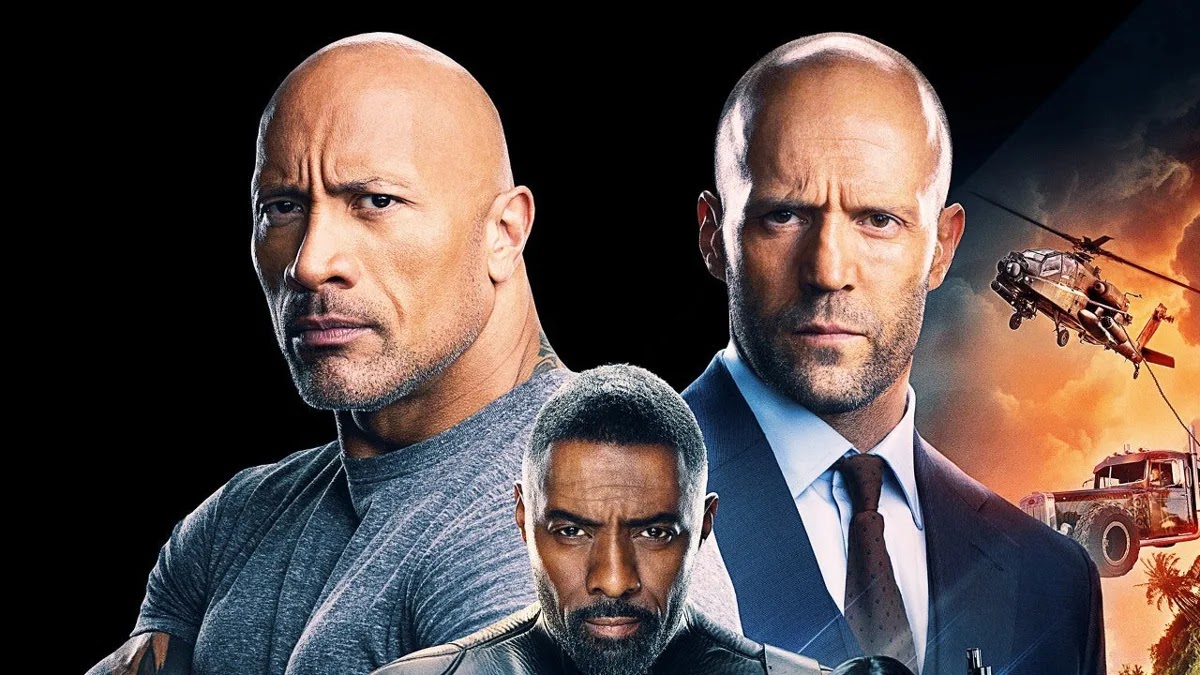
Hobbs and Shaw is fast and furious fun


This film’s Sunday name is Fast & Furious Presents: Hobbs and Shaw which is a cumbersome and slightly obvious way of tying it into a 5 billion dollar franchise. The notion that a film starring two of the biggest action stars in the business needs a bit of superfluous branding to guarantee box office success is just silly.

The reviews will be sniffy but the men and women behind Hobbs and Shaw – because, be honest, that’s what everyone is calling it will be laughing all the way to the bank. This is a film that promises exactly what it delivers and exactly what the audience wants, and that is a sure-fire recipe for success.

Apart from the fact that Luke Hobbs (Dwayne Johnson) and Deckard Shaw (Jason Statham) are key characters in the Fast and Furious franchise – in fact they gave it a much-needed shot in the arm when they turned up- there’s not much to connect this to the source material. This is more along the lines of vintage Eighties buddy action cinema. Tango and Cash (1989) comes to mind and that’s fine by me.

The plot, such as it is, concerns a deadly super-virus which threatens all mankind. Our polar opposite heroes form a mismatched team to prevent the bug from falling into the hands of genetically-enhanced supervillain Brixton (Idris Elba). The bigger issue is that the virus is currently in the blood stream of Vanessa Kirby, playing Shaw’s sister Hattie, and they have only 72 hours to extract it and contain it safely.

It’s all so much nonsense, as most of these plots are. What matters here is the execution and this is a first class example of 21st century action cinema. The heroes are oversized, the script is appropriately bantery, the stunts are spectacular, and the craft skills involved are highly impressive. A shout out too for the Glasgow locations which look impressive and seamlessly integrate with the other footage.

This is a film that does exactly what it says on the tin and that’s exactly what I want to see at this time of year.

Johnson and Statham are very good at doing what they do. They each exude their own particular brand of macho without too much difficulty. The real issue with the film for me is Idris Elba who is something of an empty suit as the bad guy. While Johnson and Statham provide a casual sort of stardust, Elba is just trying too hard.

The bad guy is a plum part in an action movie – think Alan Rickman or Jeremy Irons in the Die Hard franchise for example. Here Elba stands around spouting some heavy handed exposition and the film passes him by; it’s a role anyone could play.

The one standout performance for me – apart from two knock-out surprise cameos – comes from Vanessa Kirby as Shaw’s sister. Just as in last year’s Mission: Impossible – Fallout she is the buffer zone for all this testosterone and again does it very well.  Her character has agency in her own outcome, doesn’t need any rescuing, and contributes on the same level as the others – we could do with more of that.

The one thing that did strike me about Hobbs and Shaw and Mission: Impossible for that matter is how irrelevant they appear to have made the Bond franchise. The current James Bond movie is beset by all sorts of unfortunate problems but to be honest if it was never released, I don’t think I would miss it.

The Bourne series along with Fast and Furious and Mission: Impossible have reinvented themselves for contemporary audiences. Bond still seems mired in the 20th century so perhaps it’s time to hang up his shoulder holster and make way for the inevitable Hobbs and Shaw franchise.

Tuesday, 23 July 2019

The Current War is a fairly low wattage affair


The Current War has spent so much time wandering in the cinematic wilderness that I really wanted to like it more than I did. Unfortunately the story of the film’s time in movie purdah may be the most interesting thing about it.

The film was screened at the Toronto Film Festival two years ago and was all set for release in October 2017. However as a Harvey Weinstein production it got caught up in his legal troubles and the demise of his company. In the end all trace of Weinstein has been removed from the credits, the film has been sold to new distributors and goes on release in the UK this month and the United States in October – just two years late.

In a perfect world The Current War would be the little movie that could; triumphing over adversity and sweeping all before it at the Oscars. Sadly this is an imperfect world and its chances are slim.

Like most films showcased at Toronto this was originally seen as an Academy Awards contender. It ticks a lot of Oscar bait boxes; serious subject, period drama, big cast in mutton chop whiskers, lavish production values, and educational too. In the end though this is a pretty workmanlike affair which fundamentally lacks drama and tries to cover too much ground.

Set in the latter part of the 19th century it’s the story of the battle between two men, Thomas Edison (Benedict Cumberbatch) and Joseph Westinghouse (Michael Shannon), to bring electricity to America. It should be about the dawn of the modern age, instead it is an argument about the merits of Edison’s Direct Current system versus the Alternative Current system proposed by Westinghouse. Nikola Tesla, played by Nicholas Hoult, also pops up but gets fairly short shrift.

One big flaw is that we are given no one to root for; Westinghouse was marginally the more decent of the two but it’s a close run thing. There is no real insight into these historical ciphers. The film becomes a debate about respective philosophies and since we are never told the fundamental difference between the two systems – there’s some flimsy guff about hosepipes – we can’t really form an opinion. It’s an argument that unfolds in front of us but in which, apart from those who are electricians or physicists, we have no agency.

Director Alfonso Gomez-Rejon compensates for the basic lack of drama with a very fussy aesthetic. There are so many overhead ‘God shots’ that there should be a warning for vertigo sufferers. The camera operator also appears to be on a bungee cable as shots disappear out of the top of the frame or pan dizzyingly left or right. This endless movement took me right out of the picture. There is a difference between creating rhythm and letting the story settle.

Benedict Cumberbatch and Michael Shannon anchor the film with solid, if unspectacular performances. One advantage of the delay is that Tom Holland is now a star but he’s not given a lot to do until it’s too late and Spider-Man fans will be disappointed. Overall the effect is very stagey – this is playwright turned screenwriter Michael Mitnick’s first screenplay – and no amount of dizzy camera tricks can change that.

Given the story this film should have been better than it is but the reality is we don’t know whose story it is or why we should care. There are so many heavy-handed allusions to the development of moving pictures that the overall message seems to be that we wouldn’t be watching anything at all if it wasn’t for his contribution.

Overall The Current War is a low wattage affair in which sparks resolutely refuse to fly.


Last Night in Soho offers vintage chills in fine style

The past, as L.P. Hartley reminds us, is a foreign country where they do things differently. Yet we are often inexorably drawn to it in th...