Thursday, 8 July 2021

Another Round is a heady cocktail of moods

Sometimes it’s hard to get beyond the circumstances of a film’s production. In big, expensive movies, for example, it’s often easier to review the budget than the film, the production process casts a shadow over the finished production.

So it is with Another Round, an otherwise very good film that never quite, for me, escaped the real-life tragedy at its heart. More of that later.

The film, which won the Best Foreign Language Oscar this year, is about alcohol and our relationship with it. Written and directed by Thomas Vinterberg, it is set in Denmark, a country with a long and abiding love affair with the hard stuff. At a birthday party, along with copious amounts of booze, schoolteacher Martin (Mads Mikkelsen) and his three friends and colleagues decide to try an experiment.

They have come across a theory by an obscure scientist that says we are born without enough alcohol in our system. If we top it up by a small amount every day, then we will open the doors of perception and begin to see the world as it was meant to be.

Basically, they decide to try it. Not getting drunk, but just a little buzz on for most of the day. There are rules though – no weekend drinking – this is science after all.

Initially things go well in some very entertaining moments. They loosen up, their teaching becomes more fun, their pupils think they are cool, and their relationships start to improve.

But of course, it cannot last. Everything has  a price and, although the film focuses mainly on Martin, all four of them suffer the consequences of their experiment.

The performances are generally very good, but Mikkelsen, in particular, is excellent. Life has passed Martin by, and he hasn’t noticed. It’s all slipping away, and he is, literally, in the last chance saloon. He is clinging on by his fingernails and ironically alcohol may be his redemption.

Which brings me to the tragedy. In the film Martin has two sons, but he was supposed to have a son and a daughter. The actress playing his screen daughter, Ida Vinterberg – the director’s real-life daughter – was killed in a road accident a few days before she was due to start shooting. Vinterberg eventually finished the film, and it is dedicated to Ida.

Given that much of the comedy of Another Round has a bittersweet quality, I found myself watching the film with a melancholy air that stopped me enjoying it as much as I felt I should. It does however give the end of the film a, perhaps unintended, poignancy.

Another Round is a fine film with an air of sadness about it. Nothing quite so sorrowful though as the news that a Hollywood remake is in the works.


 

Monday, 28 June 2021

F9 - Diesel is running on empty.

Justin Lin has been away from the Fast and Furious universe – for there is such a thing – for eight years. At the rate these people drive that’s an eternity, and it shows. Lin is decidedly ring-rusty and his TV work reviving S.W.A.T and Magnum isn’t really the right preparation for the latest instalment  in a multi-billion dollar franchise.

Lin did episodes 3 -6 of the franchise but missed out on 7, 8 and 8 ½ (Hobbes and Shaw) or as I prefer to think of them, the good ones. These were the films that turned the franchise from a petrolhead fantasy into a super-spy saga. They were Bond movies for the new millennium with action, adventure, and a sense of over-the-top fun. Much of this came from ‘new boys’ Dwayne Johnson and Jason Statham who are both missing here, and it shows.

Fast & Furious 9 is like a Bond film, to be sure, unfortunately it’s one of the later embarrassing Roger Moore ones.

It has one of the clunkiest scripts I’ve ever heard; I get that no one comes to these films for the nuance, but the opening sequence of this film is sheer torture. It’s Exposition City as no thought goes unexpressed in an attempt to set up an origin story for the Toretto boys – yes, there’s more than just mopey old Dom.

Lin is operating on the spaghetti formula. There is lots being thrown at the wall; very little sticks and the film is generally undercooked.

The Toretto origin story is the backdrop for a series of random action sequences structured to fit in guest stars; everybody who has ever appeared in this film – bar Luke Evans – is shoehorned into a story about a super weapon called Ares, which can control all the tech in the world.

The film uses the Ian Fleming ‘thrilling cities’ model jumping around from Tbilisi, Edinburgh, Tokyo, and the Caspian Sea, to name a few, but thrilling cities are not that thrilling when you can’t go anywhere.

For me these films work best when Vin Diesel and his ponderous utterances about family are side-lined. Unfortunately, Vin is at the heart of it and this time he has a brother. Vin rumbles on about family while Michelle Rodriguez just looks grateful to be outside.

The complicated plot requires Diesel to run the full gamut of his emotional range – sullen, angry, and confused – sometimes all at once, like a talking crash test dummy. John Cena as his brother reminds you he’s the man you get when Dwayne Johnson is busy.

Overall, the film lacks zest, the storytelling is poor and the effects, physical and CG, are a little uneven but not as uneven as the transitions between scenes. There are three editors credited on this and it looks like they each brought their own blunt instrument.

There are one or two good moments. Ludacris and Tyrese Gibson have a neat comedy rapport, and there’s a clever stunt with electromagnets which is ultimately overdone. Despite these moments the film is generally incoherent and broadly humourless, not to mention overstaying its welcome at two and a half hours long.

Just in case you feel like burning rubber to get out of the cinema – which would be perfectly understandable – I feel obliged to point out there is a mid-credits sequence that offers some hope for the future.


Monday, 3 May 2021

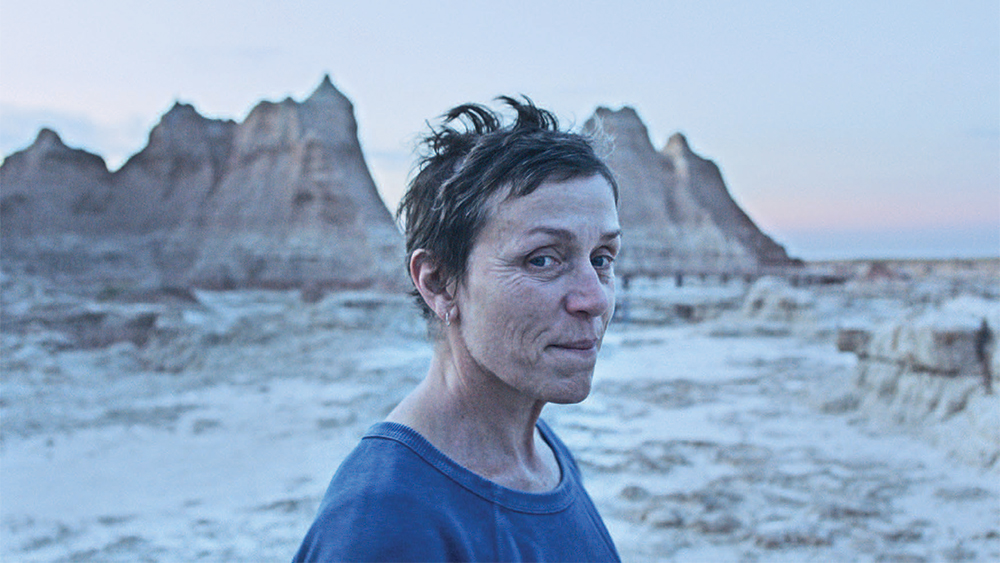
Nomadland - simply a masterpiece


Nomadland is an American classic, a masterpiece. Not just as a film but as a piece of art. Choe Zhao’s achingly tender story of modern nomads is as quintessentially American as a John Stenbeck story, or an Ansel Adams photograph, or a Georgia O’Keefe painting. There is something in this film that touches our core and speaks to us about who we are. Anyone watching Nomadland unmoved is genuinely more to be pitied than scorned.

On one level the film is a 21st century tragedy, on another it is an inspiration. Fern (Frances McDormand) has been recently widowed. Along with the loss of her soulmate comes the loss of her home when the company town she lived in effectively disappears; part of the inspiration for the film is the town of Empire, Nevada, whose postal code was discontinued as a result of globalisation.

Fern remains quietly undaunted. She makes the best of her situation, for example, pointing out to one former neighbour that she is not ‘homeless’ but ‘houseless’. The distinction speaks volumes for Fern’s character and the delivery of the line is a testament to McDormand’s peerless performance.

Fern takes to the road in search of seasonal work at an Amazon depot and begins to live in her van. Incidentally for those who claim that the picture portrayed of Amazon is too benevolent, see my comment earlier about more pitied than scorned. This is not a Michael Moore documentary, thank God, it is a film about dignity, humanity, and fellowship.

Finding friends everywhere she goes Fern discovers a sub-culture of modern American nomad who live on the road. These are not Kerouac style beatniks, they are simply people who, for one reason or another, have disconnected from the 21st century and found a life on their own terms. Most of the cast are drawn from these nomads which gives the film an air of authenticity.

Fern with her haunting melancholy undiminished is something of a participant observer in this community but she finds something in them to salve her soul and takes to the life of a nomad. Along the way she meets Dave (David Strathairn) potentially a kindred spirit, but not so much of a kindred spirit that would lead writer-director Zhao into the realms of cliche and convention.

Dave is the catalyst for a final act which reveals a little more about Fern and her relationship with friends and family. This could so easily have been a faux transcendent ending, instead – as she did in Three Billboards – McDormand offers us resolution rather than redemption.

Nomadland is a film about grief, and loss, and the consolation of humanity. It also speaks eloquently of the healing power of nature and the importance of recognising that our corporate culture is not the only way.  It calls to mind Steinbeck – not so much The Grapes of Wrath for me as Travels with Charley – and reminds us that there may still be some decency left in the world.

The film looks magnificent, shot by Zhao’s usual cinematographer Joshua James Richards. His use of natural light – especially in the golden hour – and a gently roaming handheld camera produces glorious images which are perfectly complemented by Ludovico Einaudi’s score.

At the heart of this film is McDormand. As Fern she contributes one of the great performances in the history of American cinema. So much is non-verbal. One of her very first scenes, in which she briefly embraces her dead husband’s work jacket, sets down a marker for what is effectively a master class in screen acting to follow.

That scene with the jacket recalled for me the moment in The Searchers (1956) in which Martha briefly embraces Ethan Edward’s coat in a scene that mutely but eloquently charts their unspoken love. The Searchers in particular and John Ford’s work in general came back to me several times in Nomadland.

The obvious visual comparison is with the films of Terrence Malick, and I get that, but for me Ford – who directed Grapes of Wrath – is a better tonal comparison. Like Ford at his best Nomadland is peopled with characters so believably organic that they seem to have sprung from the very land they inhabit. It is a work of genius that should on no account be missed.


Last Night in Soho offers vintage chills in fine style

The past, as L.P. Hartley reminds us, is a foreign country where they do things differently. Yet we are often inexorably drawn to it in th...